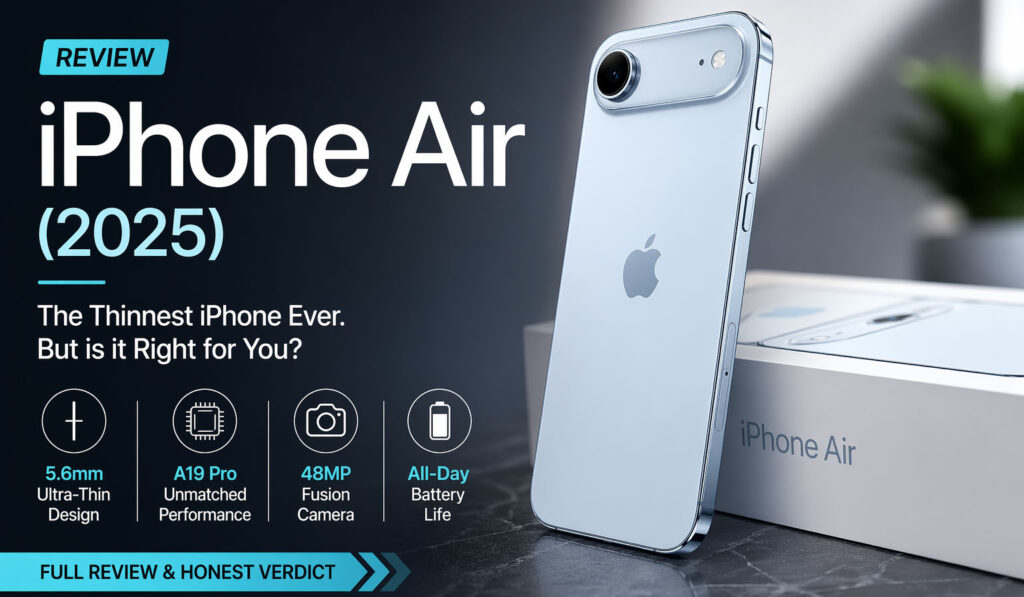
Overall Rating ⭐ 4.3/5
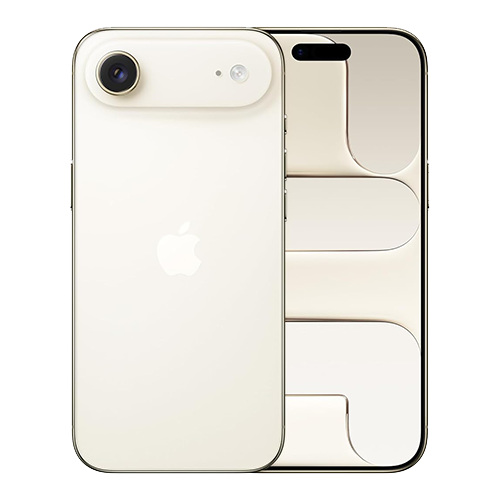
The iPhone Air is an engineering marvel that prioritizes ergonomics and style over pure, multi-lens utility. It is arguably the most comfortable flagship smartphone to hold in 2026, though it forces users to trade away some traditional “Pro” features for that ultra-slim profile.
Pros
Cons
When Apple launched the iPhone Air, most of the conversation focused on one number: 5.6mm.
That number matters, because it makes this the thinnest iPhone Apple has ever built. But after the launch hype settled, a bigger question emerged. Does an ultra-thin phone actually improve the experience, or does it create more compromises than it solves?
That’s really what this review is about.
The iPhone Air is not trying to be another Pro Max. It is doing something different. It prioritizes design, portability, and elegance over packing in every possible hardware feature.
And honestly, that makes it one of Apple’s most interesting phones in years.
Unboxing and First Impressions: That First “Whoa” Moment
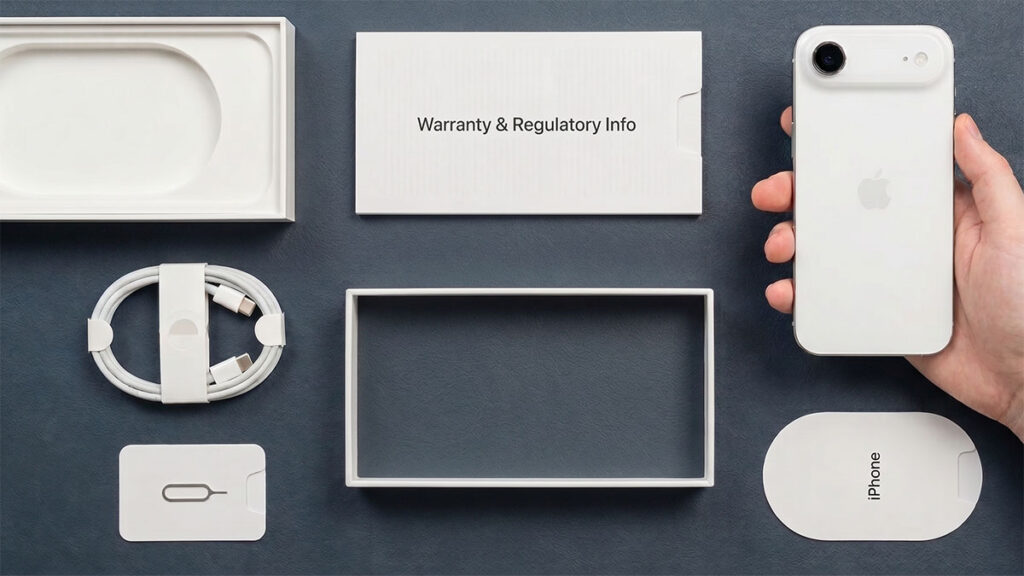
The first surprise comes even before you open the box.
It’s noticeably thinner and lighter than recent iPhone packaging, and that’s clearly intentional. Apple leans into the “Air” branding right from the start, making the entire unboxing feel focused on one idea—thinness.
Lift the lid, and the phone immediately stands out.
It doesn’t just look slim; it feels tightly built and solid in hand. The glass-and-titanium construction gives it a reassuring density, so it never comes across as fragile despite how thin it is.
Inside the box, things stay minimal.
You get a braided, color-matched USB-C cable and the usual documentation, with no plastic wrapping anywhere. It’s familiar Apple packaging, just slightly more refined and aligned with their environmental push.
Then comes the moment most people will remember.
Peel off the paper screen cover and pick it up, and your brain almost hesitates. At 165 grams, it feels lighter than expected, and your hand instinctively waits for weight that never comes.
It’s a small moment.
But it sticks.
Key Specifications at a Glance
Design: The Entire Story Starts Here
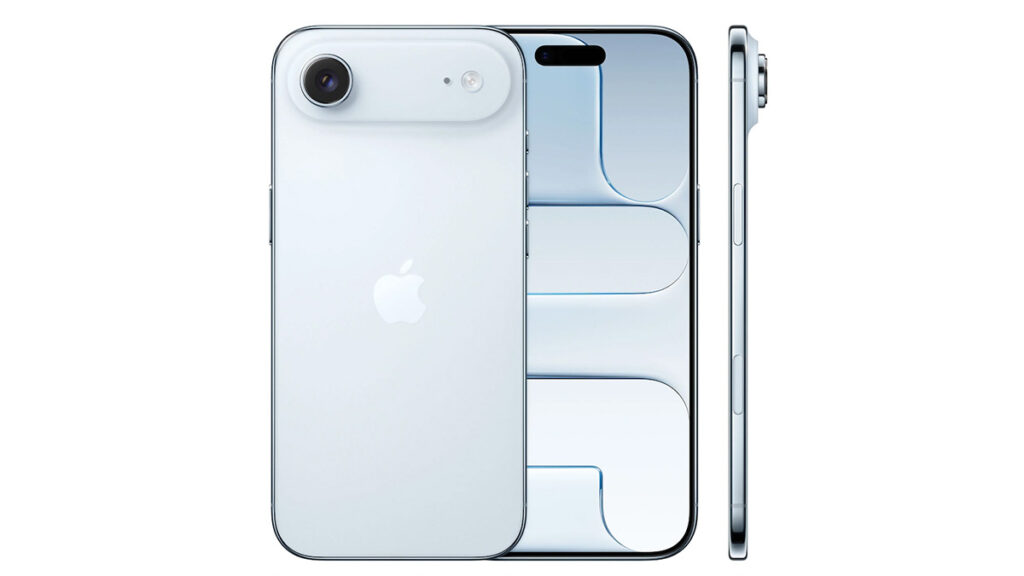
The first thing you notice about the iPhone Air is how strange it feels in hand.
Not bad strange. Unexpected strange.
At 5.6mm, it feels almost impossibly thin, especially if you are coming from a recent Pro model. Those phones feel dense and heavy by comparison. The Air feels light, almost delicate, though the Grade 5 titanium frame helps reassure you that it is not fragile.
That thinness changes daily use more than I expected.
It slides into a pocket effortlessly. It feels easier to hold for long reading sessions. Even using it one-handed feels more comfortable than many modern flagship phones.
That may sound minor.
It isn’t.
Phones have gradually become heavier for years, and most people have just accepted it. The iPhone Air pushes back against that trend.
There is a trade-off, though.
The polished titanium frame looks premium, but it picks up fingerprints quickly. And if you put a thick protective case on this phone, you partially defeat the reason for buying it in the first place.
That irony is hard to ignore.
Display: Premium in Every Sense
The 6.5-inch Super Retina XDR OLED is excellent, which is exactly what you would expect from Apple.
You get 120Hz ProMotion, deep contrast, excellent color, and up to 3000 nits peak brightness for outdoor visibility. Whether scrolling, gaming, or watching HDR video, the display feels every bit like a flagship panel.
What makes it feel slightly different is the chassis around it.
Because the frame is so thin, the display almost appears to float in your hand. It sounds like a small thing, but it changes the feel of the phone in a surprisingly immersive way.
This is simply a fantastic screen.
Performance: Surprisingly Uncompromised
I half expected Apple to use a lesser chip here.
They didn’t.
The A19 Pro, combined with 12GB of RAM, makes the iPhone Air genuinely powerful. Apps open instantly, multitasking feels smooth, and demanding games run without issue.
In day-to-day use, it behaves like a premium flagship should.
That said, there is a limit.
When you push the phone hard for long stretches, especially gaming or heavy exports, you can feel the device warm up. That is not shocking. A thinner body naturally has less room for heat management.
Physics still wins.
But for normal users, this is unlikely to be a real issue.
Camera: Excellent, But Simplified
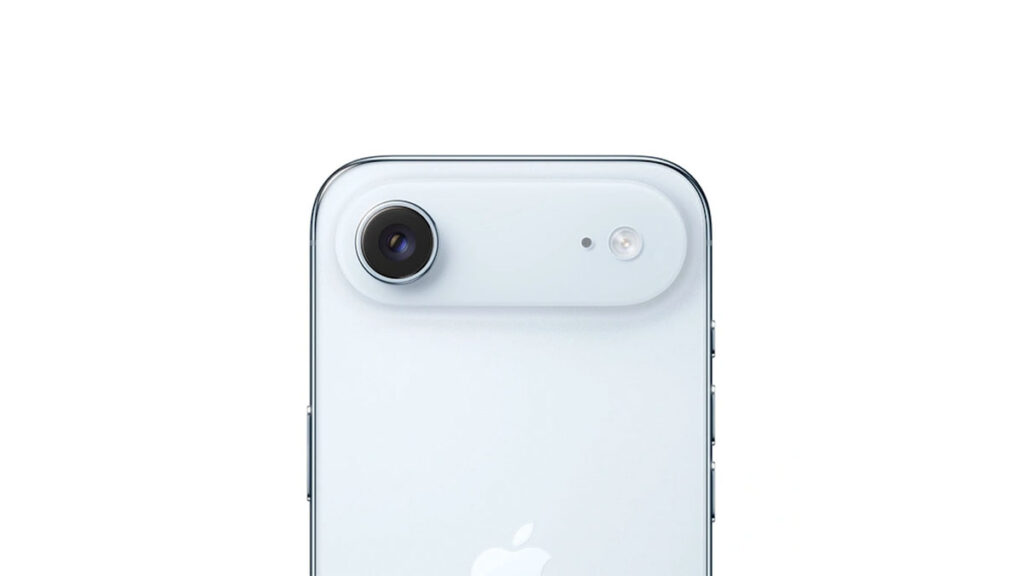
This is where the biggest compromise shows up.
Apple gave the iPhone Air a single 48MP Fusion camera, and while the main sensor itself is very good, there is no avoiding what is missing.
For everyday photography, it delivers:
That is the good part.
The limitations show up when you compare it to Pro models. You lose:
If you mostly shoot casual photos, social content, or everyday moments, that may not bother you.
If you love photography, it probably will.
Battery Life: Good… With a Clear Ceiling
Battery life is solid, but this is not a battery champion.
For average use—messaging, browsing, streaming, social apps—you can get through a day comfortably. Most users should end with some charge left.
That is the good news.
The less good news is that heavy users will likely feel the limits faster. GPS, gaming, constant 5G, or hotspot use can drain this phone quicker than thicker flagship alternatives.
And honestly, that makes sense.
You do not get extreme thinness without giving something up.
In this case, part of it is battery.
iPhone Air vs iPhone 17 vs iPhone 17 Pro
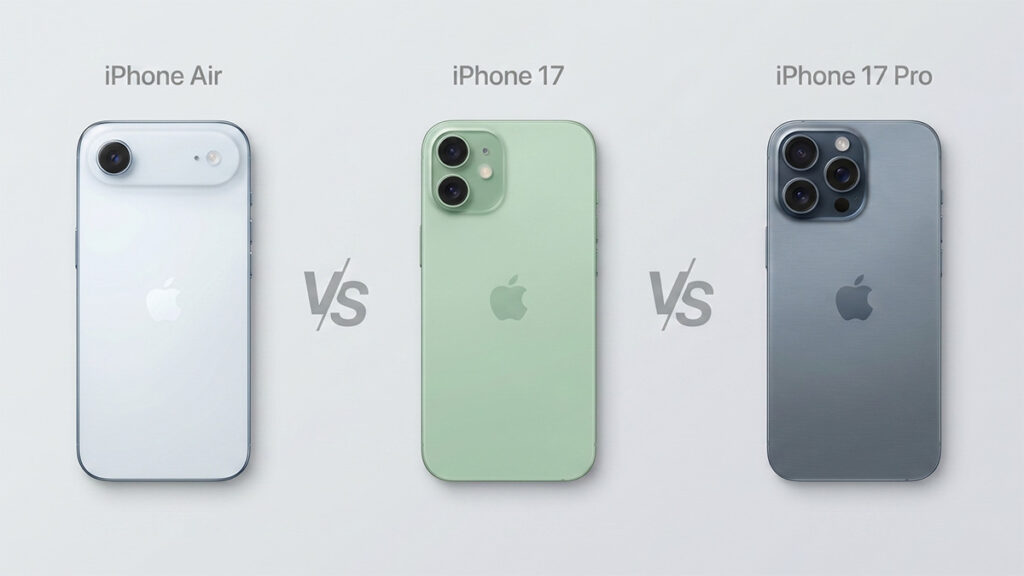
The Air sits in an unusual middle position.
It is not the value option like the base iPhone 17. It is not the feature-packed choice like the iPhone 17 Pro. It sits between them as the design-first option.
That makes it more niche.
But also more interesting.
| Feature | iPhone 17 | iPhone Air | iPhone 17 Pro |
| Starting Price | ₹82,900 ($799) | ₹99,900 ($999) | ₹1,34,900 ($1,099) |
| Design Focus | Standard/Balanced | Ultra-Thin & Lightweight | Performance & Pro Features |
| Thickness | ~7.95 mm | ~5.64 mm | ~8.75 mm |
| Weight | ~177 g | ~165 g | ~206 g |
| Display | 6.3″ Super Retina XDR | 6.5″ Super Retina XDR | 6.3″ Super Retina XDR |
| Refresh Rate | 120Hz ProMotion | 120Hz ProMotion | 120Hz ProMotion |
| Processor | A19 | A19 Pro (5-core GPU) | A19 Pro (6-core GPU) |
| RAM | 8GB | 12GB | 12GB |
| Rear Cameras | Dual (48MP Wide, 48MP Ultra-Wide) | Single (48MP Wide) | Triple (48MP Wide, Ultra-Wide, Telephoto) |
| Cooling | Standard | Passive (No Vapor Chamber) | Vapor Chamber System |
| Build Material | Aluminum | Titanium | Titanium |
| Best For | Value & All-day reliability | Style, portability, and media | Professional creative work & gaming |
That comparison tells the story pretty clearly.
Pros and Cons of iPhone Air
The iPhone Air gets several big things right:
That combination makes it a very unique device.
There are compromises too:
None of these are deal-breakers for everyone.
But they matter.
Should You Buy the iPhone Air?
Buy it if:
Skip it if:
And honestly, that may be the simplest way to understand the iPhone Air.
It is a phone built around priorities.
Final Verdict
The iPhone Air is not Apple’s most practical iPhone.
It is not its most versatile iPhone either.
But it may be its boldest.
Apple took a real risk here, and that alone makes this phone stand out. The thin design is not just marketing. It changes how the phone feels and how it fits into daily life.
That matters.
Yes, the camera system is limited. Yes, battery life makes compromises.
But for the right user, those trade-offs may feel worth it.
The iPhone Air feels elegant, fast, and genuinely different.
And in a market full of phones starting to look the same, that counts for a lot.
Review Summary
Overall Rating ⭐ 4.3/5
The iPhone Air is an engineering marvel that prioritizes ergonomics and style over pure, multi-lens utility. It is arguably the most comfortable flagship smartphone to hold in 2026, though it forces users to trade away some traditional “Pro” features for that ultra-slim profile.
Pros
Cons