
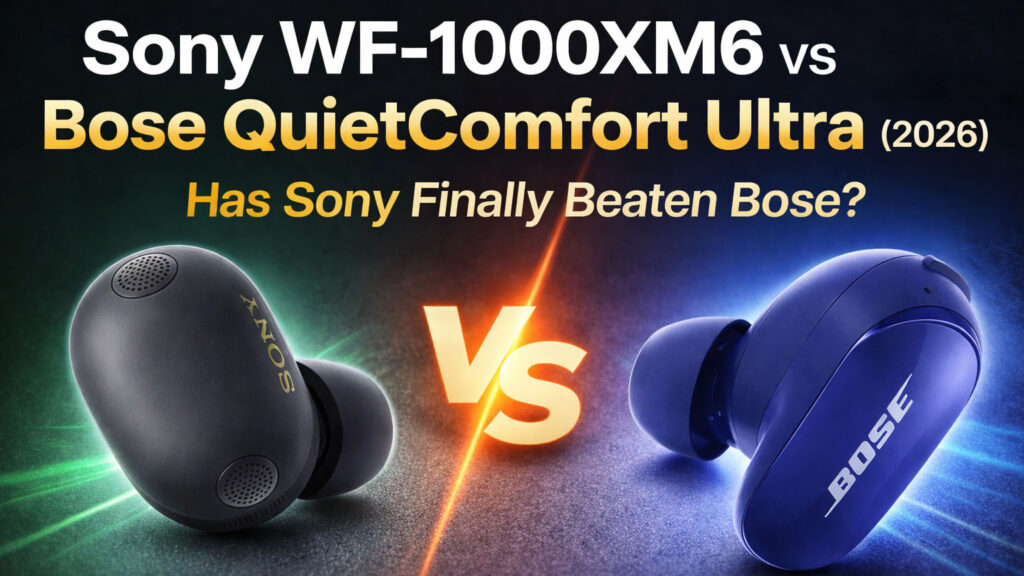
The premium true wireless market in 2026 is brutally competitive.
Every brand promises stronger noise cancellation. Deeper bass. Smarter features. Longer battery life.
Most upgrades feel incremental.
The Sony WF-1000XM6, however, feels calculated.
Sony didn’t redesign its flagship line for attention. It refined it for performance. Announced on February 12, 2026, the XM6 launches at $329.99 (Rs. 35,500) and immediately positions itself against one of the toughest competitors in audio: the Bose QuietComfort Ultra Earbuds.
And this year, the comparison feels tighter than ever.
This isn’t just about who cancels more noise. It’s about which earbuds deliver the most complete experience in daily life.
Design and Comfort: Refinement Over Flash
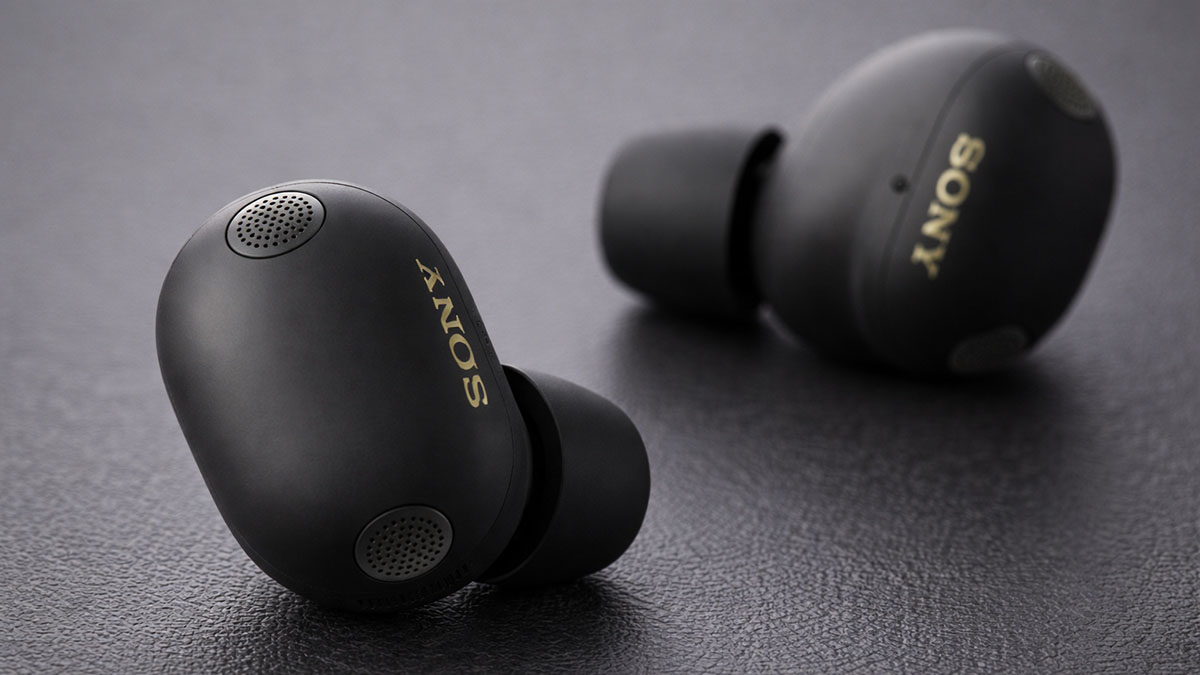
Sony’s design shift is subtle but intentional.
The glossy, pebble-like finish of the XM5 is gone. In its place is a matte texture that feels more premium and less prone to fingerprints. The earbuds are slightly larger overall but slimmer in profile — a change that improves how they sit in the ear.
The improvements aren’t dramatic, but they’re noticeable during extended use.
What Sony focused on here:
The charging case also feels sturdier, with a more structured hinge and finish. It remains pocket-friendly, but it now better reflects the flagship pricing.
Bose takes a different approach. The QuietComfort Ultra includes stability bands that anchor the earbuds firmly during movement. For workouts or running, Bose may feel more locked in. For long workdays or travel sessions, Sony feels more natural and less intrusive.
Both are comfortable. The difference depends on usage style.
Water resistance remains IPX4 on both models — suitable for workouts and light rain, but not full submersion.
Active Noise Cancellation: Sony Is No Longer Playing Catch-Up
This is where the real battle happens.
Sony introduces the new HD Noise Cancelling Processor QN3e, paired with eight microphones across both earbuds. The company claims:
In real-world environments, the XM6 performs impressively. Office chatter softens. Street traffic fades. Café noise becomes background texture rather than distraction.
The Adaptive NC Optimizer works quietly in the background, adjusting based on surroundings and even atmospheric pressure changes during flights.
What stands out most is how smooth it feels. There’s less artificial “ear pressure” sensation compared to older aggressive ANC systems.
Now, how does it compare to Bose?
Bose still has a slight edge in deep low-frequency rumble — think airplane engines or bus vibrations. Its cancellation feels denser in sub-bass territory.
But in dynamic environments — city streets, train platforms, unpredictable noise patterns — Sony often feels more responsive.
For the first time in years, Sony and Bose are effectively equals in ANC performance. The difference is no longer obvious. Fit and ear shape may matter more than brand.
Sound Quality: Balanced Precision vs Energetic Excitement
Sony’s tuning philosophy hasn’t changed dramatically — but it has matured.
The WF-1000XM6 delivers a balanced and spacious sound signature. Bass is controlled rather than boosted. Vocals are clear and slightly forward. High frequencies are crisp without becoming harsh.
Technically, the XM6 supports:
This gives listeners real flexibility. You can fine-tune warmth, clarity, or bass response depending on preference.
Bose takes a more opinionated route. The QuietComfort Ultra delivers a bass-forward, energetic profile. Its Immersive Audio feature creates a more dramatic spatial presentation that many users find engaging for pop, hip-hop, and electronic music.
The difference comes down to listening philosophy.
Sony sounds more neutral and adaptable.
Bose sounds more immediately exciting.
Audiophiles who enjoy tweaking EQ settings will gravitate toward Sony. Casual listeners who prefer strong bass out of the box may prefer Bose.
Call Quality: A Quiet but Meaningful Upgrade
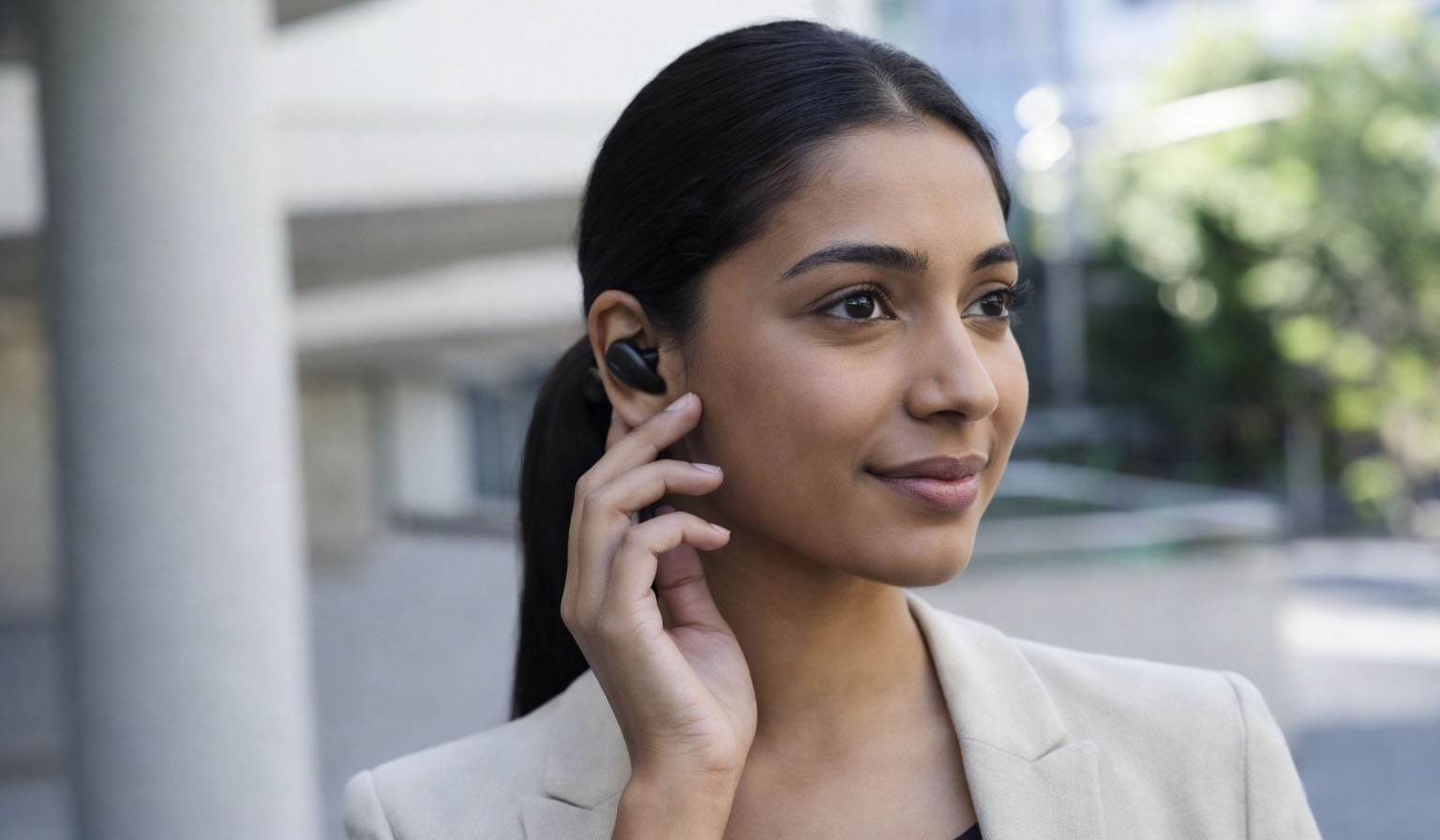
Call clarity is where Sony quietly made major gains.
The XM6 integrates:
In outdoor or moderately noisy environments, voice clarity remains strong. Background sounds are minimized without distorting speech.
Bose performs well too, but Sony holds a slight advantage in windy conditions and chaotic surroundings.
If you rely on earbuds for work calls, meetings, or travel communication, this improvement adds real value.
Battery Life: Practical Superiority
Battery life isn’t flashy — but it matters.
Sony offers up to 8 hours of playback with ANC enabled. Bose delivers around 6 hours under similar conditions.
Both provide roughly 24 hours total with their charging cases. Both support quick charging and wireless charging.
But those extra two hours per charge from Sony can mean:
In daily use, Sony’s endurance advantage becomes noticeable.
Software and Ecosystem Depth
Sony’s companion app remains one of the strongest in the industry. It includes advanced features such as:
This depth gives Sony an ecosystem advantage. It feels customizable and forward-looking.
Bose keeps things simpler. Its Immersive Audio feature is compelling, but overall app customization remains limited compared to Sony.
If you enjoy control and feature depth, Sony clearly offers more.
Quick Specs Side-by-Side
| Feature | Sony WF-1000XM6 | Bose QuietComfort Ultra |
|---|---|---|
| Launch Price | $329.99 (Rs. 35,000) | ~$299 (Rs. 18,990) |
| ANC | Adaptive, highly competitive | Slight edge in deep rumble |
| Battery (ANC On) | 8 hours | 6 hours |
| Total Battery | 24 hours | 24 hours |
| Audio Codecs | SBC, AAC, LDAC, LC3 | SBC, AAC |
| Bluetooth | 5.3 + Auracast | 5.3 |
| Water Resistance | IPX4 | IPX4 |
| EQ Customization | 10-band | Limited |
On paper, Sony offers broader codec support and longer battery life. Bose remains strong in raw low-frequency ANC and brand reputation.
Pros and Cons
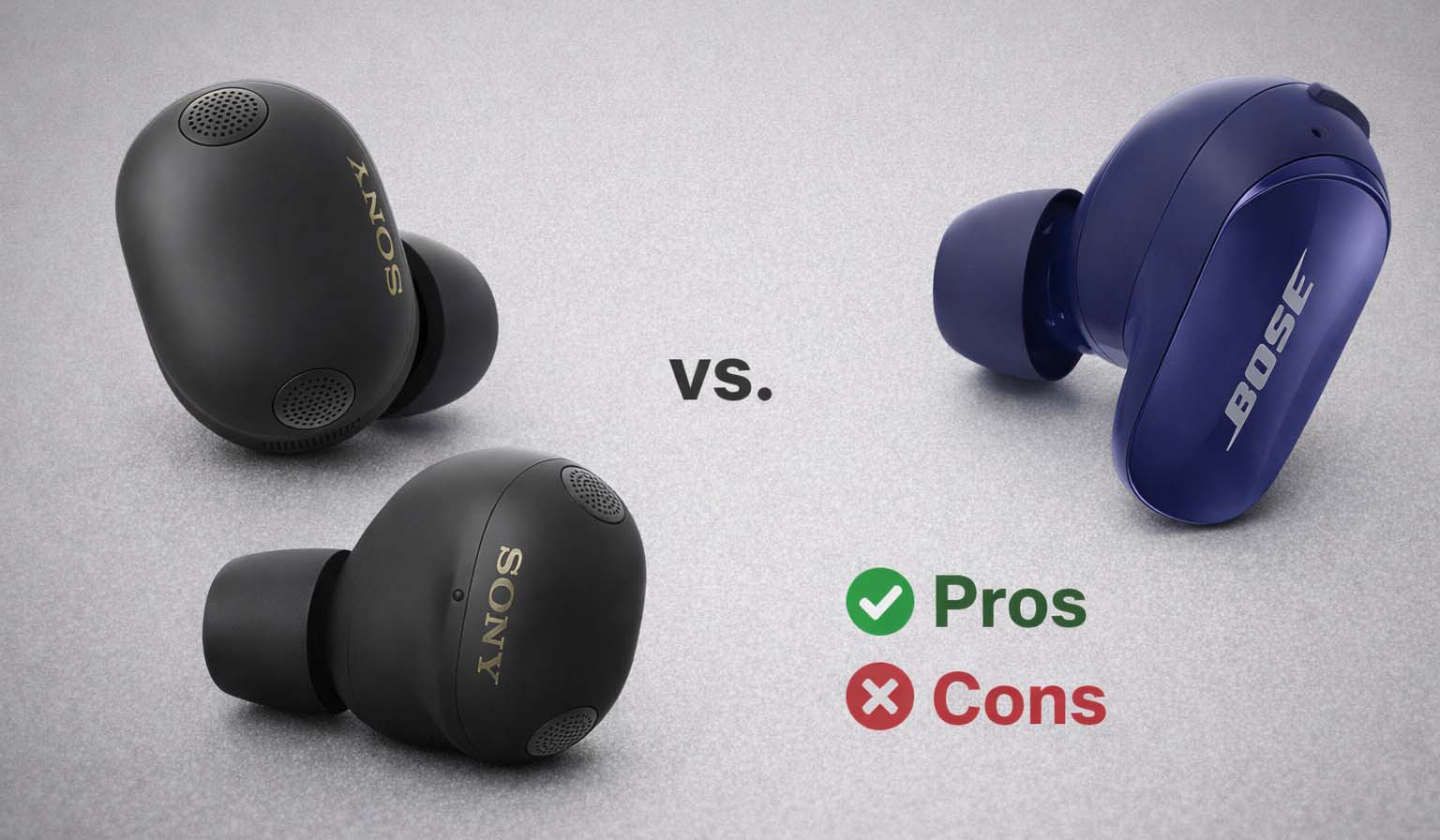
Sony WF-1000XM6
Pros
Cons
Bose QuietComfort Ultra
Pros
Cons
Who Should Buy Which?
At this level, neither the Sony WF-1000XM6 nor the Bose QuietComfort Ultra is a bad choice.
The difference comes down to what you value most in daily use.
Let’s make it simple.
Buy the Sony WF-1000XM6 If You Want the Most Complete All-Rounder
The XM6 feels like the more balanced flagship in 2026. It doesn’t dominate Bose in one dramatic category — but it performs exceptionally well across almost all of them.
You should choose Sony if:
The XM6 is ideal for professionals, commuters, frequent travelers, and listeners who prefer control over their audio tuning.
If you want a “set it up once and it does everything well” kind of flagship — this is it.
Buy the Bose QuietComfort Ultra If ANC Depth and Bass Matter Most
Bose still holds a slight edge in one specific area: deep, low-frequency noise cancellation.
If you fly often or spend time around constant engine rumble, Bose may create a slightly denser silence bubble.
You should choose Bose if:
The QuietComfort Ultra is perfect for bass lovers and frequent flyers who want powerful isolation without tweaking settings.
Should WF-1000XM5 Owners Upgrade?
If you already own the Sony WF-1000XM5, this is refinement — not reinvention.
You gain:
But the XM5 remains competitive. The decision depends on how much you value incremental improvements.
For new buyers entering the premium segment in 2026, however, the XM6 represents Sony’s most balanced and complete offering yet.
Final Verdict: The More Complete Flagship?
Bose still delivers arguably the strongest deep low-frequency noise cancellation available in true wireless earbuds.
But the Sony WF-1000XM6 feels more holistic.
It combines competitive ANC, refined tuning, stronger battery life, deeper customization, and excellent call clarity into a cohesive package.
It doesn’t dominate in one single dramatic category.
It wins through balance.
And in 2026, balance might be the most important feature of all.
For most users seeking a long-term flagship earbud, the Sony WF-1000XM6 feels like the smarter overall choice.
