
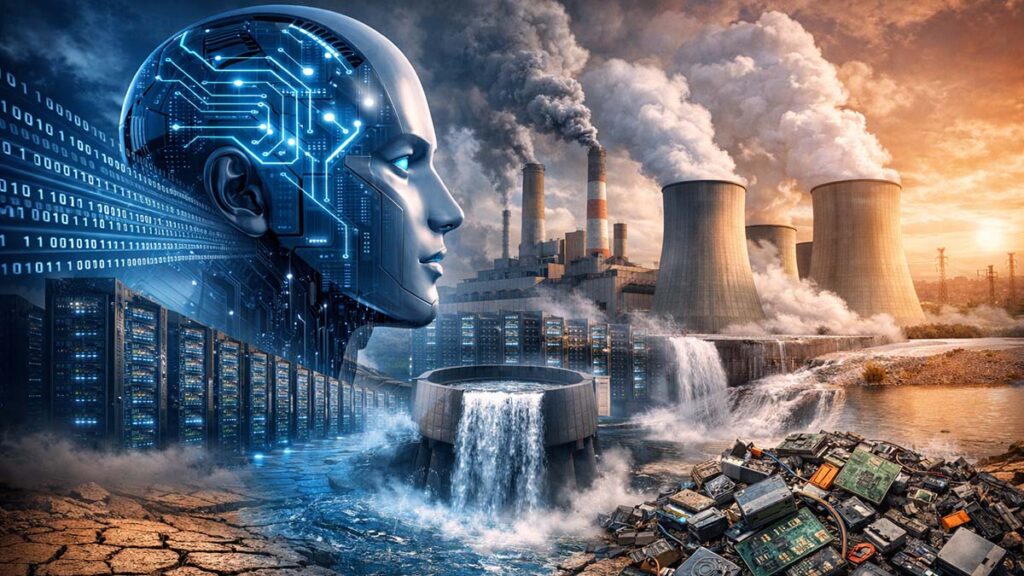
AI doesn’t feel heavy.
You type a prompt.
You get an answer.
No smoke. No noise. No mess.
But behind every smart reply, image, or prediction is something very real—and very resource-hungry.
As the AI boom of 2025 hits full speed, a quieter story is starting to surface. One that doesn’t show up on your screen. One that lives inside massive data centers, power grids, and water systems around the world.
And the bill?
It’s getting expensive—for the planet.
AI’s Carbon Footprint Is Bigger Than You Think
A recent report from Digiconomist dropped a hard truth:
AI-related CO₂ emissions in 2025 now match the entire annual carbon footprint of New York City.
Let that sink in.
For years, we’ve talked about the “cloud” as if it floats somewhere above us. But the cloud isn’t light or invisible. It’s physical. Huge. And extremely power-hungry.
Think warehouse-sized data centers.
Packed with GPUs.
Running 24/7.
Why AI Uses So Much Energy
AI’s energy use comes from two main stages:
To meet this demand, some tech companies have even kept coal and gas plants running longer than planned—undoing years of clean-energy progress.
AI Is Also Extremely Thirsty
Carbon isn’t the only problem.
According to the same report, AI-related water use has now surpassed global bottled water consumption.
Yes. Really.
Why Data Centers Need So Much Water
Servers get hot.
Very hot.
To stop them from melting, data centers use evaporative cooling systems—basically boiling off water to pull heat away from the hardware.
Millions of gallons.
Every year.
Per facility.
The Local Water Problem
The bigger issue isn’t just how much water AI uses—but where it comes from.
Many major data centers are built in already water-stressed regions like:
That means tech companies are competing directly with:
In 2025, this tension has boiled over. In several tech-heavy regions, citizens are protesting—sometimes aggressively—over water being prioritized for server cooling instead of crops and drinking water.
The Growing E-Waste Mountain
AI doesn’t just consume resources.
It discards them too.
The pace of hardware upgrades is brutal.
AI chips from 2023?
Already outdated by 2025.
That creates a growing pile of e-waste—much of it packed with rare earth materials like lithium, cobalt, and copper.
Mining these materials often means:
And when old chips are dumped instead of recycled, toxic chemicals can seep into soil and groundwater.
Out of sight.
But not harmless.
Governments Are Pushing Back
This week’s report didn’t go unnoticed.
More than 200 environmental organizations, including Greenpeace and the Sierra Club, have formally urged the U.S. government to step in.
Their demands are clear:
No greenwashing.
No vague promises.
Real numbers. Real accountability.
Is There a Cleaner Way Forward?
Surprisingly—yes.
And AI itself may help lead the way.
What “Green AI” Looks Like
It’s not guaranteed.
But it’s possible.
The Real Responsibility Starts With Us
AI feels free.
But it isn’t.
Every prompt uses electricity.
Every image consumes water.
Every model upgrade leaves waste behind.
The Digiconomist report is a reminder of something simple—but uncomfortable:
Digital actions still have physical consequences.
The challenge moving forward isn’t to stop AI.
It’s to use it wisely.
Because intelligence without restraint isn’t progress.
It’s excess.
And the future of AI shouldn’t come at the cost of the planet that supports it.